Illegal Secondary Suites in Calgary: What Buyers Need to Know
Should you buy a property with an illegal suite in Calgary?
Yes, but it depends. That's the honest answer, and it's worth unpacking instead of giving you a flat yes or no.
This applies whether you're looking at a single-family home, a half duplex, or a full duplex. The basics are the same regardless of property type, so this covers the full picture in one place.
What the City of Calgary actually calls this
I sat in on a presentation from the head of the City of Calgary's Secondary Suite Program, and this stuck with me. As far as the city is concerned, there's no such thing as an "illegal suite." There are only legal secondary suites, meaning ones that are permitted, inspected, and registered with the city. If it's not registered, the city doesn't consider it a suite at all. It's just extra living space in a basement, full stop.
So where does "illegal suite" come from? That's the terminology used by the real estate board, in MLS listings, and in everyday conversation, specifically so buyers and sellers can quickly tell the difference between a home with a registered secondary suite and a home with a basement setup that isn't registered. It's practical shorthand, not the city's official language. I use "legal" and "illegal" across this site for the same reason: that's the language you'll see on listings and the language most people search for. Worth knowing the distinction going in, though.
What actually qualifies as a legal secondary suite
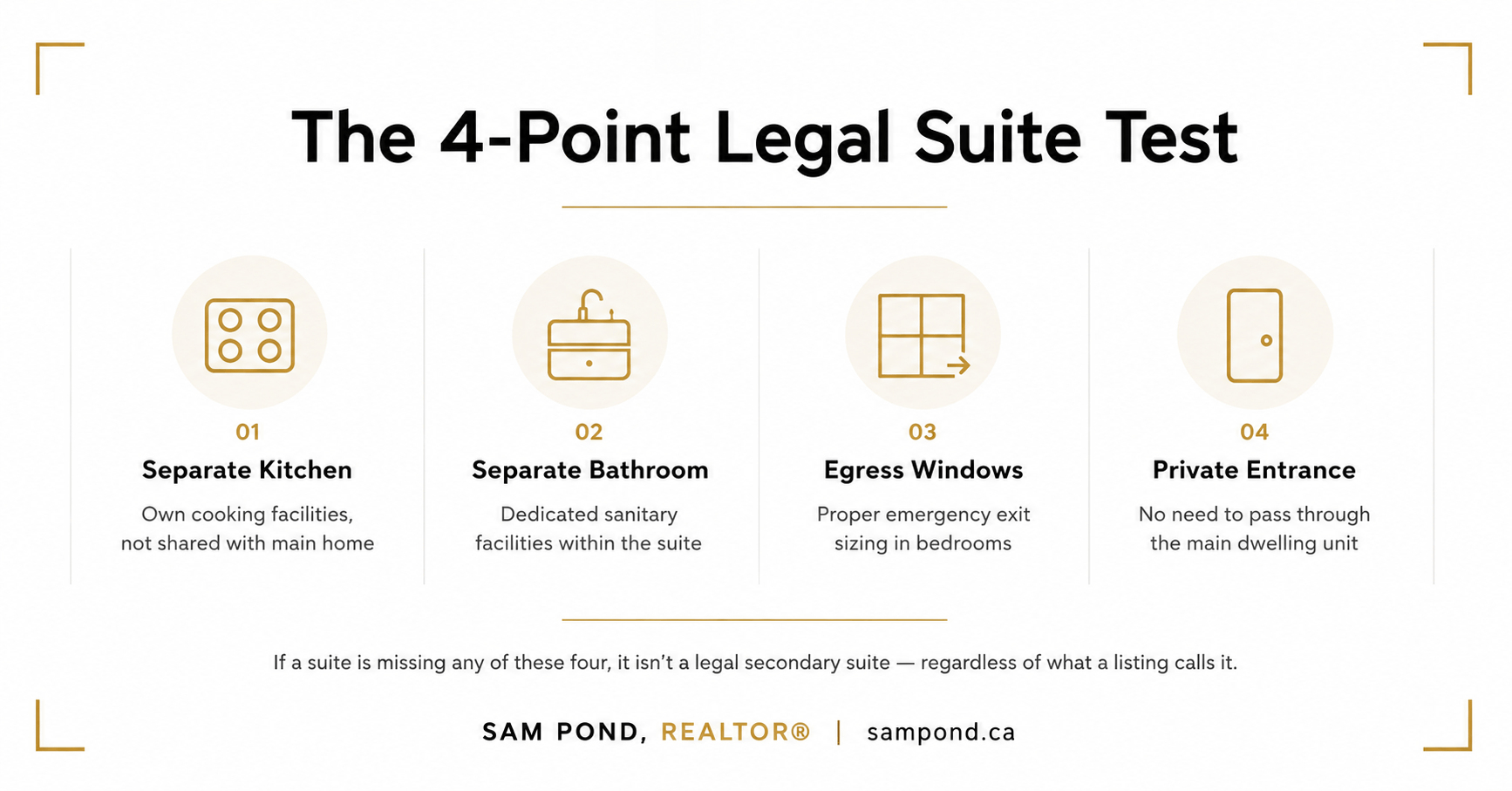
The city's definition is specific. A legal secondary suite must be a self-contained space with its own kitchen, living area, sleeping area, and bathroom. On top of that, it needs proper egress windows in the bedrooms (a code requirement so people can get out safely in an emergency), and its own entrance that doesn't require walking through the main home. A shared stairwell is fine, but each unit needs a private entrance.
If a basement is missing any of that, whether it's egress windows, a separate entrance, or a dedicated bathroom, it's not going to qualify as a legal suite even if someone applies to register it. This is the actual test. A suite that's missing even one of these four things is what people mean by "illegal suite," regardless of how nice the space looks.
A few resources worth knowing about if you're looking into this seriously:
- The city runs a Suite Registry where you can look up whether a specific address has a registered legal suite on file.
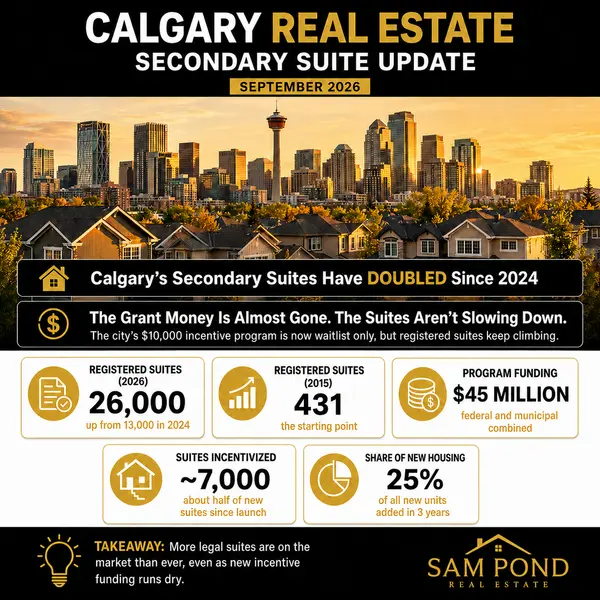
- There's a Secondary Suite Incentive Program offering up to $10,000 per qualifying homeowner to help with the cost of legalizing a suite, though funding is limited and applications are reviewed on a first-come, first-served basis. This one isn't just a line item I read about. I used it with my son Hunter when we legalized the suite in the home he bought, and it made a real difference in the cost of getting it done properly.
- If you already own a property with an unregistered suite, the city has a specific process to legalize an existing suite.
What illegal actually means
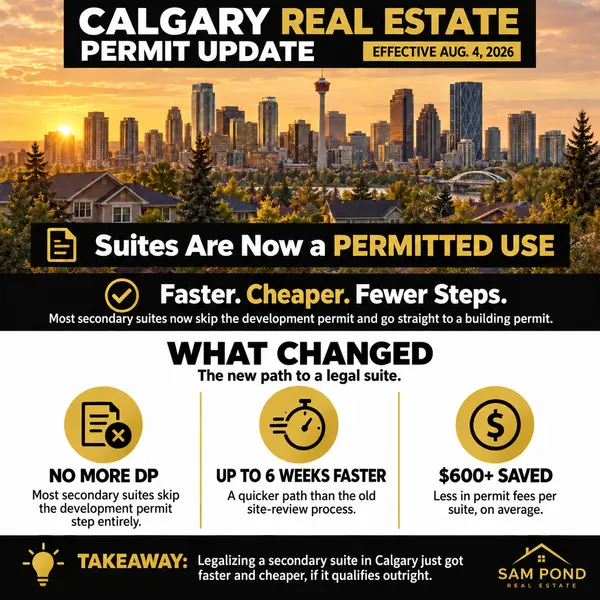
Nobody's coming to arrest you for owning a property with an unregistered basement suite. What it actually means is there's no development permit or building permit on file with the city for that space. That matters for a few practical reasons, not moral ones:
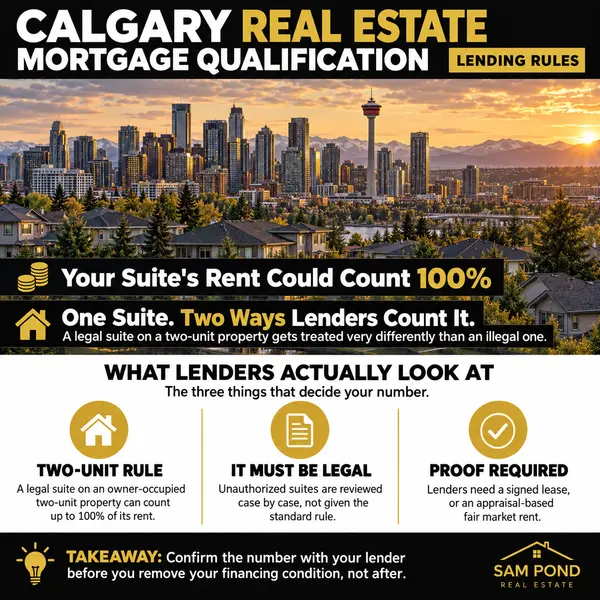
- Financing. Some lenders won't count rental income from an illegal suite toward your mortgage qualification. Others will, with conditions. This varies a lot, so it's worth confirming with your mortgage broker early, not after you've written an offer.
- Insurance. Your insurance provider needs to know the suite exists, legal or not. If something happens and they find out later, you could have a real problem with a claim. Always disclose it.
- Resale. Some buyers won't touch a property with an unauthorized suite. Others don't care at all, especially investors who see it as a mortgage helper regardless of paperwork. Your buyer pool narrows a bit, but it doesn't disappear.
- Enforcement. The city generally isn't going door to door. Complaints usually come from neighbours, or a suite gets flagged during an unrelated inspection or renovation permit. Low risk, not zero risk.
Why do people buy them anyway
Most of the time it comes down to numbers. A legal suite costs more to build or convert, sometimes a lot more, once you factor in permits, egress windows, fire separation, and inspections. An illegal suite is often already there, already rented, already generating income. If the price reflects that risk, and it usually does, the math can still work out in your favour.
I think about these properties in terms of where someone's headed, not just what they're buying today. A suite isn't just a feature on a listing. It's a mortgage helper now, and maybe a full income property later, once someone retires, moves for work, or just wants a rental instead of selling.
This isn't just a professional opinion for me. I've helped both my sons buy their first homes. For James, we added a legal suite from the start. For Hunter, we legalized an existing suite in the home he bought. Two different starting points, same underlying idea: get the mortgage help now, keep the option open for the long run.
Can you legalize it later?
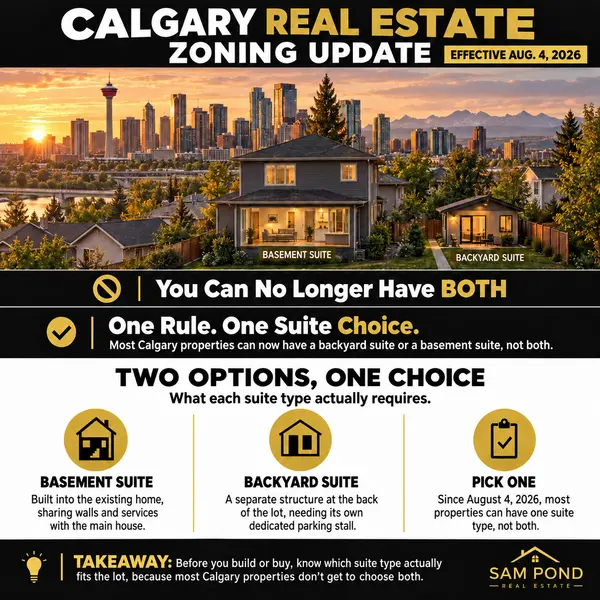
Sometimes, yes. It depends on things like ceiling height, window sizes, fire separation between floors, and whether the lot and zoning even allow a secondary suite at all. Some suites are a straightforward permit application away from legal. Others would need real renovation work to meet code, and at that point, you're weighing the cost of legalizing against just leaving it as is.
This is exactly the kind of thing worth walking through with real numbers before you commit to a property, not after. The city publishes actual permit costs and timelines if you want a realistic sense of what legalizing involves before you get into a specific property.
How I'd walk you through this
- Understand your situation. Are you buying to live in it and rent the suite, buying purely as an investment, or thinking about it as a future income property? The answer changes everything else.
- Explore the real options. Buy as is, buy and legalize, buy and hold as is long term. There's usually more than one path, not just the one the listing agent is pushing.
- Simplify the numbers. What does financing actually look like with or without the rental income counted? What's insurance going to cost? What would legalizing run, roughly, if you went that route?
- Support the decision. No pressure, no push toward the biggest number. Just clarity on what you're actually taking on.
- Execute. If it's the right fit, we move forward with a clear picture of what you own and what it means.
A few honest questions people ask
Is it illegal to rent out an unauthorized suite in Calgary? It's not a criminal matter, but the city can require you to stop renting it or bring it up to code if it's flagged, usually through a complaint or an unrelated inspection. Enforcement is inconsistent, which is part of why so many of these suites exist and keep operating for years without issue. That's not a guarantee, just a reality.
Will a bank give me a mortgage on a property with an illegal suite? Often yes, but whether they'll count the rental income toward your qualification varies by lender. Worth confirming with your mortgage broker before you're deep into an offer, not after.
Does an illegal suite hurt resale value? It narrows your buyer pool somewhat, since some buyers avoid them. It doesn't usually kill the sale. Plenty of investors specifically look for these properties because the price reflects the risk.
What's the difference between an illegal suite and a legal one? A legal suite has a development permit and building permit on file, meets fire separation and egress requirements, and is registered with the city. An illegal suite is functionally the same living space, just without that paperwork and code compliance. Worth knowing that the City of Calgary itself doesn't use the term "illegal suite" at all. As far as the city's concerned, there are only legal secondary suites. Anything else is just unregistered space. "Legal" and "illegal" are real estate board terminology, used because it's the fastest way for buyers and sellers to tell the two apart. For the full breakdown on what qualifies and why the premium is usually worth it, read Legal Secondary Suites in Calgary: What Buyers Need to Know.
Why do realtors call it an "illegal suite" if the city doesn't use that term? Because it's useful shorthand. MLS listings and buyers need a quick way to flag whether a basement setup is registered with the city or not, and "legal" versus "illegal" does that in two words. The city's own language is stricter: to them, it's either a legal secondary suite or it's not a suite at all.
Browse properties by type
- Single Family Homes With Legal Suites
- Single Family Homes With Illegal Suites
- Half Duplex With Legal Suites
- Half Duplex With Illegal Suites
- Full Duplex With Legal Suites
- Full Duplex With Illegal Suites
- Full Duplex, No Suite
If you're weighing a property like this, it's worth talking through the actual numbers before you rule it in or out. In the past six months alone, I've helped three buyers purchase homes with suites, two with legal suites already in place, and one with an illegal suite bought with eyes open on the tradeoffs. One of the two legal-suite buyers actually started out looking at a home with an illegal suite before changing course. If you want to know what changed his mind, that story's in Legal Secondary Suites in Calgary: What Buyers Need to Know. Every situation's different, and that's exactly the point.
Recent Posts