Calgary Real Estate Market Update: August 2026
Calgary Real Estate Market Update: August 2026
Is Calgary's housing market slowing down across the board now, or is it still just condos? As of July's data, it's starting to broaden. Apartment condos have carried most of the price softening in Calgary for months, but in July detached and row homes eased too, not by a lot, but enough to notice. Sales are down, new listings are down even more, and months of supply is creeping up across nearly every property type. Here's what the numbers actually show and what it means depending on where you sit.
Market Overview
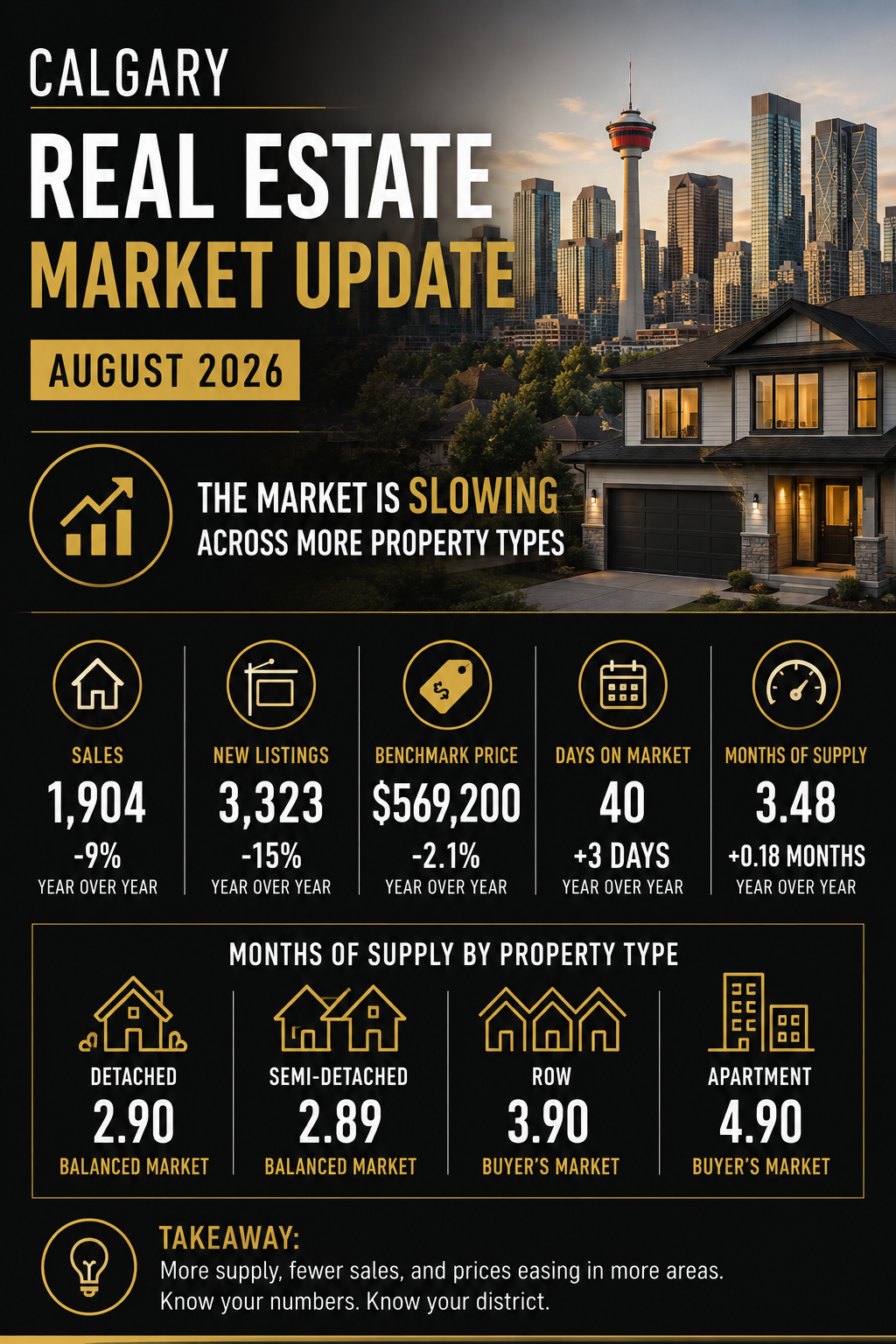
Calgary saw 1,904 home sales in July, down nine per cent from the same month last year. New listings pulled back even further, down 15 per cent to 3,323, which kept the sales to new listings ratio steady at 57 per cent despite the slower overall pace.
The bigger shift is in pricing. The total residential benchmark price came in at $569,200, down just over two per cent year over year. Apartment condos remain the clearest source of downward pressure, down over eight per cent to $297,600, now 13 per cent below their 2024 peak. But detached homes eased too this month, down just under two per cent to $743,900, driven mostly by softening in the North East and North districts. Row homes fell about six per cent, and semi-detached held closest to flat.
Homes are also taking longer to sell. The citywide average sits at 40 days on market, up from 37 a year ago. Detached homes are still moving fastest at 33 days, while apartments are taking the longest at 54.
Months of supply is the number worth watching most closely right now. Citywide it's at 3.48 months, up from 3.30 a year ago, but that figure hides a lot of variation. Detached and semi-detached sit at a fairly balanced 2.90 and 2.89 months. Row homes have climbed to 3.90, and apartments are at 4.90, both clearly in buyer territory.
Interest Rate Context
The Bank of Canada held its policy rate at 2.25 per cent on July 15, the sixth consecutive hold. The tone from the Bank's latest Monetary Policy Report was a bit more optimistic than earlier in the year. Canada's economy showed signs of picking back up in the second quarter, with growth estimated around two and a half per cent, and the unemployment rate held at 6.5 per cent in June. Inflation is still a bit elevated because of higher oil prices tied to the conflict in the Middle East, but the Bank expects it to ease gradually and return to its two per cent target by early 2027.
The next rate announcement is scheduled for September 2. With six holds in a row and an economy that appears to be stabilizing, most signs point to another hold, though the Bank has said it's prepared to adjust if conditions change.
What It Means for Buyers
Rising months of supply across most property types means more room to negotiate than you had a year ago, particularly with apartment condos, where prices are down over eight per cent year over year and supply sits near five months. It's worth understanding why that pressure exists: there are over 17,000 apartment-style units still under construction across Calgary, so it isn't likely to ease quickly.
If a detached home is more your focus, location still matters a great deal. The West District remains the tightest in the city, under two months of supply, while the North East is sitting over five months with the steepest price softening for that property type. North West communities like Sherwood, Kincora, Evanston, Sage Hill, and Nolan Hill are holding a relatively balanced 2.62 months of supply for detached homes, with prices down a modest 3.52 per cent year over year, which is worth a look if you want more selection without a fully buyer-favoured market.
What It Means for Sellers
Pricing has to do more work than it did a year or two ago. With days on market climbing citywide and buyers having more to compare against, a well-priced, well-presented home is still the one that moves. That's especially true if you're selling a condo or row home, where supply is elevated and prices have softened the most this year. Detached and semi-detached sellers are in a steadier position, particularly in the West, South, and South East districts, where conditions remain closer to balanced than buyer favoured.
What It Means for Investors
The rental side of the market adds context that resale data alone doesn't capture. According to liv.rent's July 2026 Calgary rent report, the city-wide average for an unfurnished one-bedroom rose slightly to $1,469 a month, while furnished one-bedrooms increased to $1,624. Every Calgary quadrant recorded lower unfurnished one-bedroom rents than a year ago, ranging from a 1.7 per cent decline in the Southwest, still the most resilient premium rental market in Alberta, to steeper drops elsewhere in the region.
When resale prices and rents are softening together, the cash flow math on a new purchase deserves closer scrutiny than usual. An apartment condo might look attractive on price alone, but if rents in that same building or neighbourhood are also under pressure, the numbers may not work the way they would have a year ago. Detached properties with legal suite potential, particularly in North West Calgary where supply remains comparatively tight, continue to offer a steadier combination of price stability and rental demand.
It's a quieter market than it was a year ago, and the softening that started with condos is starting to touch other corners of the city too. None of that changes the fundamentals of a good decision: know your numbers, know your district, and don't let a headline talk you into or out of something that doesn't fit your actual plans.
This post is for general market information only and isn't financial or investment advice. Figures are current as of the publish date and are drawn from CREB's July 2026 statistics package and media release, the Bank of Canada, and liv.rent's Alberta rent report.
Recent Posts