How to House-Hack Your First Home in Calgary: A Guide for Families
Can House-Hacking Actually Get Our Family Into a First Home?
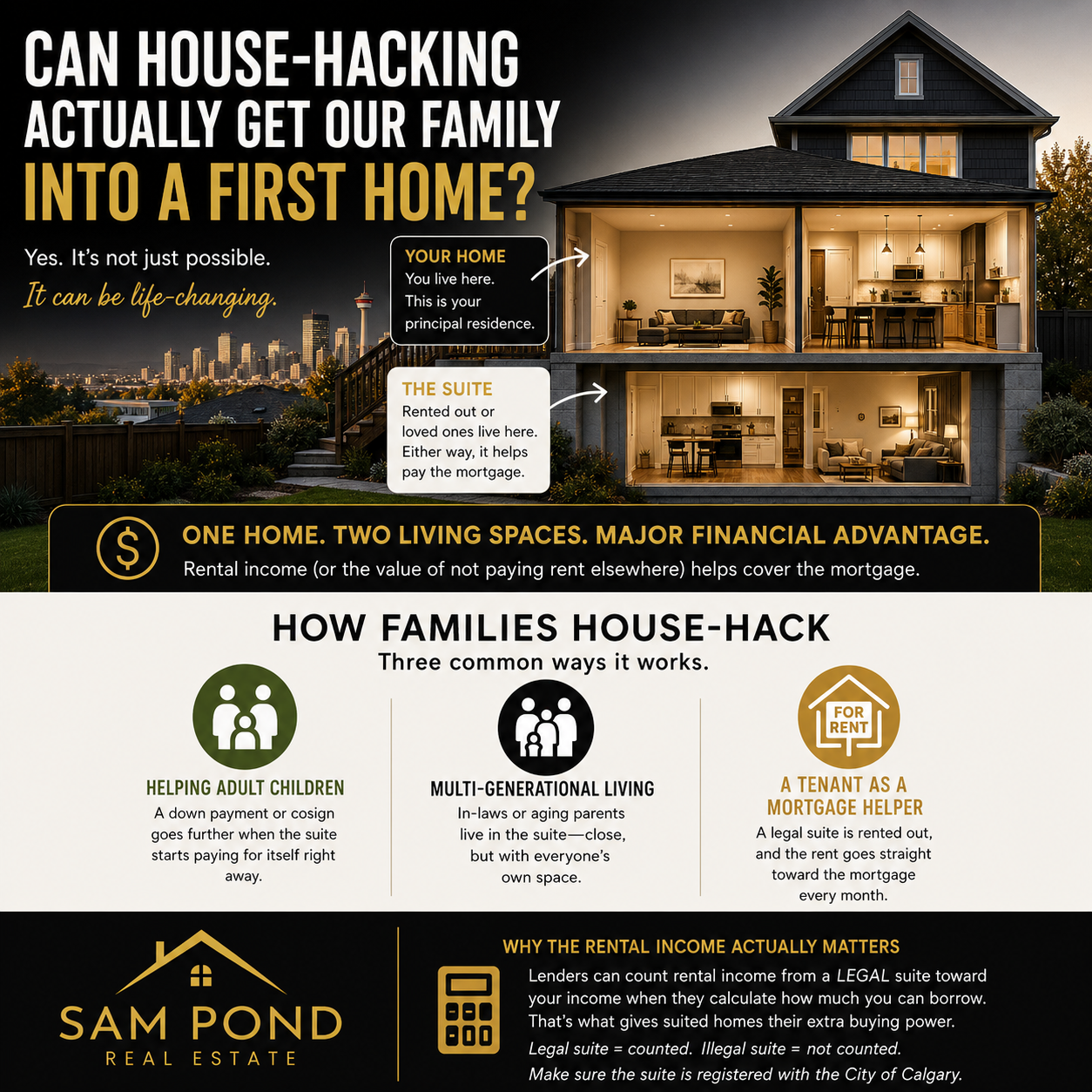
Yes, but it depends on how you structure it. House-hacking just means buying a home with a suite, living in part of it, and renting out the rest so a tenant covers part of the mortgage. It's not a new idea, but it's picked up a lot of attention lately because of how much it can change what a family can actually afford in Calgary.
People tend to picture house-hacking as a young single buyer thing, someone renting out a spare room to strangers. For families, it usually looks different, and often better. A suite can house a tenant paying market rent, but it can just as easily house an adult child, a parent, or in-laws, while the rental income (or the equivalent value of not paying rent elsewhere) still does the same job: making the mortgage easier to carry.
What It Actually Looks Like for a Family
The most common setup is a basement suite, though a legal suite in a duplex or a garage/laneway suite can work the same way. You live in the main part of the home, and the suite either gets rented out or houses family. Either way, the math is the same. Part of the home's carrying cost gets covered by someone other than you.
For families specifically, a few patterns come up again and again:
Parents helping an adult child buy. A down payment or co-signer goes further when the home has an attached suite, because the suite starts paying for itself right away instead of the whole mortgage resting on one income.
Multi-generational living. In-laws or aging parents move into the suite rather than a separate place, keeping everyone close while still giving each household its own space.
A tenant as a mortgage helper. The straightforward version. A legal suite is rented out, and the rent goes straight toward the mortgage every month.
I'll be honest, this isn't just something I recommend to clients. My wife and I live in one of our own suited properties, with her parents in the other suite. It's multi-generational living by design, together, but with our own space when we need it. When I talk to families about whether this could work for them, I'm not describing a theory.
Why the Rental Income Actually Matters
The reason house-hacking changes what a family can afford comes down to how lenders qualify a mortgage. Rental income from a legal suite can count toward your income when a lender calculates how much you can borrow, which is what gives suited homes their extra buying power. I've walked through the actual math on this in "Priced Out of Calgary? How a Basement Suite Increases Your Mortgage Approval", worth a read if you want to see real numbers.
The word doing the heavy lifting there is legal. If the suite isn't registered with the city, most lenders won't count the rent toward your application at all, no matter how reliable the income actually is. That's the difference between a suite that helps you qualify and a suite that's just extra square footage on paper. "Legal Secondary Suites in Calgary: What Buyers Need to Know" covers what makes a suite legal and how to check before you buy. If you're looking at a home with a suite that isn't registered, "Illegal Secondary Suites in Calgary: What Buyers Need to Know" is worth reading first.
What to Think Through Before You Commit
A few things worth working through as a family, not just as a buyer:
Are you actually okay being a landlord, or a family that shares walls with in-laws? Both come with a learning curve. Neither is right for everyone, and that's fine to admit before you're committed to a mortgage.
Does the suite need to earn rent right away, or is it there for later? Some families use the suite as a mortgage helper now and plan to move their parents in down the road, or vice versa. Either plan is fine as long as the numbers work under the plan you're actually going to use, not the best case.
Have you checked that the suite is registered, or budgeted to legalize it? A home priced like it has a legal suite should actually have one. If it doesn't yet, factor in the cost and timeline to get it there before you count on the income.
A Real Example
My wife and I helped our youngest son, Hunter, buy his first home this way. We cosigned and helped with the down payment, but what mattered most was steering him toward a home with a suite rather than just the first place he could afford. I wrote about that whole decision in "Helping Your Child Buy a Home in Calgary: Why a Suited Property is the Best Investment", if you want to see how it played out in practice.
Is This Right for Your Family?
House-hacking isn't the answer for everyone, and it shouldn't be forced onto a family that just wants a quiet starter home with no tenants and no shared walls. But if affordability is the real barrier standing between your family and a first home, or between helping your kid buy one, it's worth running the actual numbers before deciding it's out of reach.
A Few Honest Questions People Ask
Do I have to live in the suite, or can I live in the main house? Either works for qualifying, as long as you occupy one part of the property as your principal residence. Most families live in the main house and rent or house family in the suite.
Can I house-hack a home I already own without a suite? Yes, if zoning allows it. You'd go through the same legalization process as buying a place that needs the suite added.
Does the suite have to be rented to a stranger to count? No. What matters to most lenders is that the suite is legal and could reasonably generate rent, not who's actually living in it.
How much of the rental income will a lender count? It varies by lender, and changes periodically, so confirm current numbers with a mortgage professional before you count on a specific figure.
What if my in-laws or adult kids live in the suite instead of paying market rent? That's common, and it still supports your application in most cases, since lenders are usually looking at the suite's rental potential, not just what's actually being collected. A mortgage professional can confirm how your specific lender treats it.
If you're trying to figure out whether a suited home could actually get your family into your first house, I'm always glad to run the real numbers with you before you rule it out.
This article is for general education. It isn't mortgage, legal, or property management advice. Rental income treatment, qualifying ratios, and suite legalization requirements vary by lender, property, and situation, and can change over time. Always confirm current details with a licensed mortgage professional and, where relevant, the City of Calgary before making decisions.
Recent Posts