Should You Sell Your Calgary Home This Fall or Wait Until Spring?

Should you sell your Calgary home this fall or wait until spring?
Yes, but it depends. Over the past year, spring has been the stronger season for sellers, with homes selling faster and closer to asking price. But waiting five or six months has real costs, and last spring wasn't a big price win. If you have to sell, or want to sell, fall is a reasonable time. If you can truly choose either, the numbers lean toward spring, with some catches.
Who this is for: Calgary homeowners deciding when to list.
If you're sitting on this decision, the worry usually isn't the paperwork. It's the nagging thought that you'll list now, spring will turn out better, and you'll have left money on the table. Or you'll wait and the market will cool further and you'll wish you'd gone sooner. Neither fear is silly. Let's look at what the data actually shows so you're not deciding on a hunch.
What a year of Calgary numbers shows
These are city-wide figures from the Calgary Real Estate Board (CREB) monthly statistics packages. All of it is averaged across every kind of home, so your own property type and area will differ.
- Last fall (Sept to Nov 2025): homes took 42 to 49 days to sell on average and sold at 97.4% to 97.7% of list price.
- This fall so far (Sept 2026): 44 days on market and 97.39% of list price.
- Winter (Dec 2025 and Jan 2026): 53 days on market in both months, selling at 97.1% to 97.7% of list.
- This spring (April to June 2026): 34 to 37 days on market, selling at 98.0% to 98.3% of list.
So spring homes sold anywhere from several days to a couple of weeks faster, and most of a percentage point closer to asking, than they did in fall and winter. On a $600,000 list price, the gap between about 98.2% and about 97.4% is around $4,800. That's real money, but it's the average gap, not a promise for your house.
Why not just wait, then?
Because spring 2026 wasn't higher than spring 2025. CREB's benchmark price (a measure of a typical home's value) was $572,800 in September 2025. It slipped to $554,400 by January 2026, then climbed back to $572,500 by June 2026. So it dipped in winter and recovered by spring. But in April, May and June 2026 prices were still 3.5%, 3.0% and 2.1% below the same months a year earlier. If you waited for spring hoping for a price bump over the previous year, the data didn't hand you one.
Because spring also brings more competition. New listings in April to June 2026 ran between about 3,800 and 4,200 a month. In September 2026 there were 3,354. By November 2025 that had dropped to 2,251, and December had 1,219. More sellers means more homes for a buyer to compare yours against.
Because waiting costs money. You'll carry the mortgage, property tax, insurance and utilities for the extra months on a home you want to sell. Add those up for your own situation. Compared with a gap of a few thousand dollars, they can matter.
Why not rush to list this month?
Because the market slows as the holidays get closer. In 2025, days on market went from 43 in October to 49 in November and 53 in December, and sales dropped from 1,885 in October to 1,126 in December. Listing in late November or December means fewer buyers out looking, although also fewer homes competing with yours. Months of supply (how long it would take to sell everything listed) stayed in a similar range through the winter, between about 3.4 and 3.6, so fewer listings didn't automatically mean a stronger market for sellers.
What actually decides it for you
Your own deadline. A job move, a purchase you've already lined up, or a mortgage renewal date will usually beat any seasonal pattern.
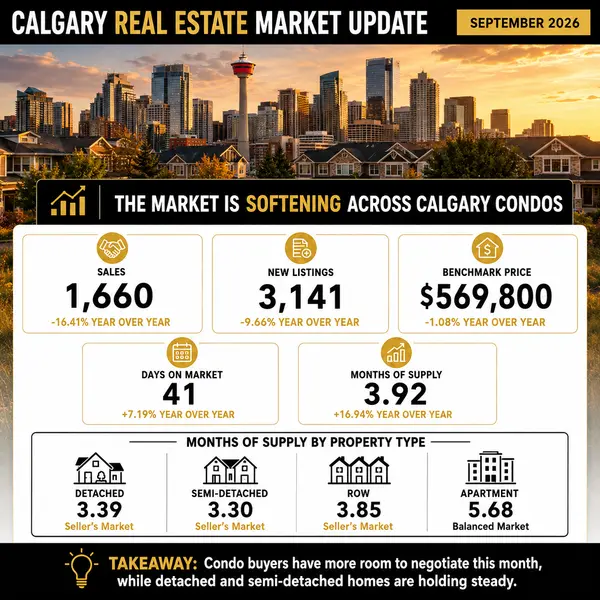
Your property type. CREB's September data shows detached homes had about 3.3 months of supply, while condos had about 5.3. Detached sellers have more room to pick their timing. Condo and row sellers face more competition and softer prices all year, so waiting doesn't fix that.
Your home's condition. If you need a few weeks for repairs, paint and photos anyway, a listing in early spring might be the natural plan.
Your tenant, if you have one. If you rent out a suite, check your lease end date and the notice rules before you choose a listing date. We went through those rules in What Being a Landlord Actually Looks Like When You Own a Calgary Legal Suite.
Interest rates. The Bank of Canada held its policy rate at 2.25% on September 2, and its next announcement is October 28, 2026. Nobody can reliably time rates, so I'd treat that as one input, not the reason to pick a season.
For the broader monthly picture, see Calgary market overview: October 2026.
Questions people ask
Is it better to sell a house in the fall or spring in Calgary?
Over the past year, spring sold faster and closer to list price than fall. But spring 2026 prices were still below spring 2025, and waiting adds carrying costs. It depends on your deadline and property type.
What is the best month to sell a house in Calgary?
In CREB's data from the last year, April through June had the shortest days on market (34 to 37) and the highest sale-to-list ratios (98.0% to 98.3%). Past results don't guarantee next spring.
Do house prices drop in winter in Calgary?
Last winter they did. The benchmark price fell from $572,800 in September 2025 to $554,400 in January 2026, about 3.2%, then recovered to $572,500 by June 2026.
Is it hard to sell a house in Calgary in winter?
It's slower. December 2025 had 1,126 sales versus 1,885 in October, and homes took 53 days on average. Fewer buyers are looking, though fewer homes are competing with yours.
Should I wait to sell until interest rates drop?
Nobody can reliably time that. The Bank of Canada's rate is 2.25% with a decision on October 28. Base your timing on your own plans and numbers first.
If you're torn on timing, I'm happy to run your home's numbers with you and lay out both options side by side. No rush on it.
This post is general education about Calgary real estate and isn't legal, financial or professional advice. Figures are CREB city-wide monthly statistics from September 2025 to September 2026. Past seasonal patterns don't predict future results, so confirm details for your own home with a REALTOR® and, where needed, your lender or lawyer.
Recent Posts